A year ago, Hamza Abdelkarim was struggling to secure meaningful minutes at Al Ahly. Now, the 18-year-old is being considered by Barcelona as a possible solution to their need for a recognised centre-forward.
His rise has been exceptionally rapid. Abdelkarim went from the bench in Cairo to a surprise place in Egypt’s World Cup squad, before featuring for Barcelona’s first team, scoring against Al Ahly in the Joan Gamper Trophy and finishing pre-season as the club’s leading scorer.
That progress has raised an important question: is Abdelkarim ready to lead Barcelona’s attack, or would the arrival of an established striker actually provide the best environment for his development?
To understand his current position, it is important to consider where his journey began.
Abdelkarim left Al Ahly without being an established first-team starter. He did not have a substantial record of senior goals or appearances to make a move to Europe appear the natural reward for a series of outstanding achievements.
Most of his opportunities had come in competitions of lesser importance, meaning his transfer was initially viewed as a bet on potential rather than recognition of a fully developed career.
His next major step came when Egypt manager Hossam Hassan selected him for the World Cup, a decision that surprised many observers given the teenager’s limited experience at senior level.
Abdelkarim played in four matches at the tournament, totalling 56 minutes. He neither scored nor provided an assist, so the statistics alone do not offer evidence of an exceptional individual campaign.
The value of the experience lay elsewhere. At 18, Abdelkarim found himself alongside players such as Mohamed Salah and Omar Marmoush, while facing the intense pressure and scrutiny of a World Cup. Egypt reached the last 16 for the first time in their history.
His move to Barcelona was already a significant leap, but his performances during pre-season made the story even more striking.
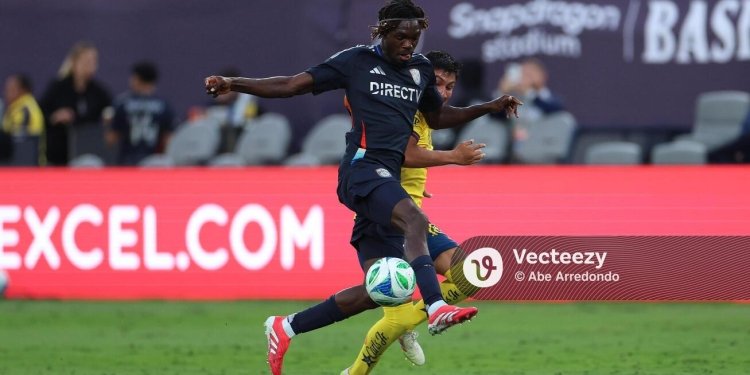
Rather than simply taking part in first-team training, Abdelkarim seized his opportunities and placed himself in contention for the centre-forward role. He scored twice against Birmingham City, found the net against Basel and scored against Al Ahly in the Joan Gamper Trophy.
Those goals took his pre-season total to four and prompted Barcelona manager Hansi Flick to discuss him in more serious footballing terms than simply praising a promising youngster.
Flick highlighted Abdelkarim’s ability to attack crosses, hold up the ball and move effectively inside the penalty area. Those qualities are central to what Barcelona require from their principal striker.
The debate at the club therefore moved on. It was no longer only about whether Abdelkarim deserved an opportunity with the first team, but whether he could play a genuine role during the new season.
The clearest indication may have come from Flick and sporting director Deco themselves.
After the victory over Al Ahly, Flick confirmed that Barcelona were still looking for another recognised striker. Deco, meanwhile, stressed how difficult it would be to replace a player of Robert Lewandowski’s stature.
That suggests Barcelona do not want to begin a long campaign relying entirely on a teenager who has yet to complete a full season in European football.
However, the search for another striker should not automatically be interpreted as a negative judgement on Abdelkarim. Barcelona can be convinced by his talent while also believing it would be unreasonable to place the entire responsibility for their attack on an 18-year-old.
At first glance, the arrival of another forward appears likely to harm his prospects. It could reduce his available minutes and make a place in the starting line-up harder to secure.
From the perspective of his development, though, the situation may be more beneficial.
Abdelkarim did not arrive at Barcelona after a long period as a regular for Al Ahly or a complete season in the Egyptian league. He moved after initially searching for opportunities, then went to the World Cup and soon afterwards found himself involved with Barcelona’s first team.
That extraordinary acceleration can be a strength, but it also carries a risk if it leads to expectations that exceed his current experience.
If he became Barcelona’s main striker immediately, every match would bring a new test. A goal would lead to claims that he was the discovery of the season. Three games without scoring would invite comparisons with Lewandowski. A missed decisive chance could become the focus of criticism, while any decline in the team’s form would make the centre-forward position one of the first places examined.
That is a heavy burden for an 18-year-old.
An experienced first-choice striker would offer Abdelkarim a different path. He could train every day alongside a top-level forward, study his movement and learn from him, while still receiving meaningful opportunities in La Liga, the domestic cups and the Champions League.
He could start matches when Flick rotates his team without being expected to decide the outcome of every game.
The central irony of Abdelkarim’s story is that what appears less attractive for him now may ultimately be better for his future.
Not signing another striker would give him more starts and a more prominent position in Flick’s plans. But an established forward could offer something even more valuable: time.
Time to learn without excessive noise, make mistakes without turning them into a crisis, play without being expected to rescue Barcelona, gain experience of La Liga and the Champions League, and understand the demands of a full season rather than a successful pre-season.
In two or three years, the equation could look entirely different. Abdelkarim may have developed from a player seeking minutes at Al Ahly into a forward with dozens of appearances for Barcelona, experience against Europe’s best defenders, Champions League exposure and a deeper understanding of the pressure attached to the Catalan shirt.
Only then would the question of whether he is ready to become Barcelona’s main striker be completely logical.
For now, the more useful question is how the club can maintain the speed of his progress without forcing him to skip vital stages.
Seen from that perspective, a new striker is not necessarily an obstacle to Hamza Abdelkarim’s dream. He may instead be one of its strongest allies: carrying the responsibility of the present while Abdelkarim quietly prepares to carry the burden of the future.