Uefa’s 55 member associations will stage an emergency meeting later this week to decide how to respond to Fifa’s plan to sell stakes in its flagship competitions, with the prospect of a World Cup boycott expected to be discussed.
Fifa has outlined proposals to create a new commercial subsidiary to run its main tournaments, including the World Cup, and to allow external investors to buy into that company. World football’s governing body argues the move would generate significantly more income to distribute to national associations worldwide.
However, the idea has triggered alarm in Europe over the potential influence of private investors on the sport’s showpiece events and the future structure of the international calendar.
Uefa fury over ‘crossed a line’ plan
European football’s governing body took the unusual step of publicly attacking the proposals even before Fifa formally released them on Tuesday, issuing a strongly worded statement in response to initial reports in the Financial Times and the Times.
Uefa condemned the project and said Fifa had “crossed a line”. The Football Association later revealed it had not been consulted before the proposals were published, shortly after Uefa’s criticism appeared.
The emergency meeting will be held virtually and is intended to allow European associations to coordinate their stance and consider potential collective action.
Given the anger generated by the proposals, senior figures across Europe believe it is inevitable that a World Cup boycott, even if only as a theoretical option, will be aired during the discussions.
European leverage over Fifa
Uefa controls only 55 of Fifa’s 211 member associations, but it encompasses most of the game’s leading national teams and clubs.
Six of the eight quarter-finalists at this summer’s World Cup were European, including eventual winners Spain. In the 2022 World Cup five of the last eight came from Europe; in 2018 the figure was six.
European officials are acutely aware that any Fifa competition would be far less attractive to broadcasters, sponsors and fans if Uefa’s members were absent.
At the heart of the dispute is Fifa’s claim that it must explore commercial options to accelerate the global growth of football. That has raised concern that, in the drive for additional revenue, Fifa’s major events – the men’s and women’s World Cup and the corresponding Club World Cup – could be staged more frequently and expanded to include more teams.
With the football calendar already under strain, not least because of the continued growth of European club competitions, any further expansion or increased frequency of Fifa tournaments would have major knock-on effects for domestic leagues, players and clubs.
Compared to European Super League threat
One senior figure within the English game told BBC Sport the Fifa plan represented one of the most serious challenges football has faced in recent years, describing it as being on a par with the European Super League project that collapsed within 48 hours amid widespread opposition in 2021.
There is little expectation within the European game that Fifa will retreat as rapidly from its current proposals.
Fifa says its new commercial strategy is intended to drive development funding to unprecedented levels, with a stated aim of increasing global support to $10bn (£7.5bn). It also plans to give each of the 211 member associations the chance to access up to $20m (£15m) in one-off capital.
Strained Fifa-Uefa relations deepen
The row marks the latest flashpoint in an increasingly fractious relationship between Fifa and Uefa. Tensions flared in 2021 when Fifa considered holding the World Cup every two years, a concept driven by former Arsenal manager and current Fifa chief of global football development Arsene Wenger. Uefa reacted angrily at the time and helped galvanise opposition that ultimately stalled the proposal.
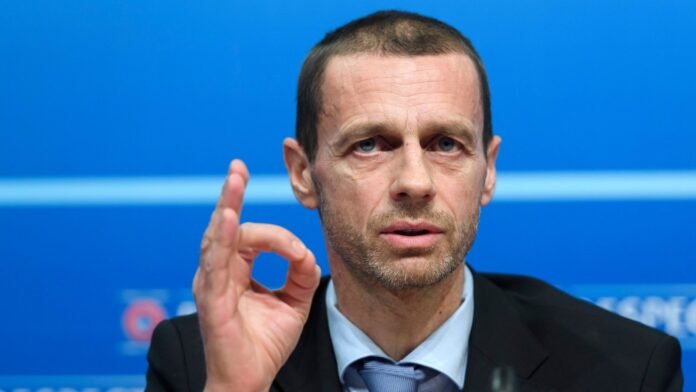
Relations have deteriorated further in recent months. Uefa president Aleksander Ceferin boycotted this month’s World Cup final in protest at a series of controversial decisions around the tournament.
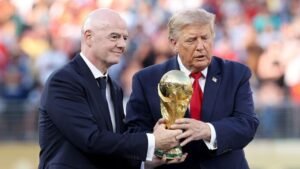
Among them was the intervention of US President Donald Trump in the disciplinary process that saw USA forward Folarin Balogun’s one-match ban turned into a suspended sanction, enabling him to play in the last-16 tie against Belgium.
Uefa’s emergency meeting later this week is expected to set out Europe’s next steps – and will give an early indication of whether talk of a potential World Cup boycott gathers real momentum or remains a negotiating threat in an escalating stand-off with Fifa.