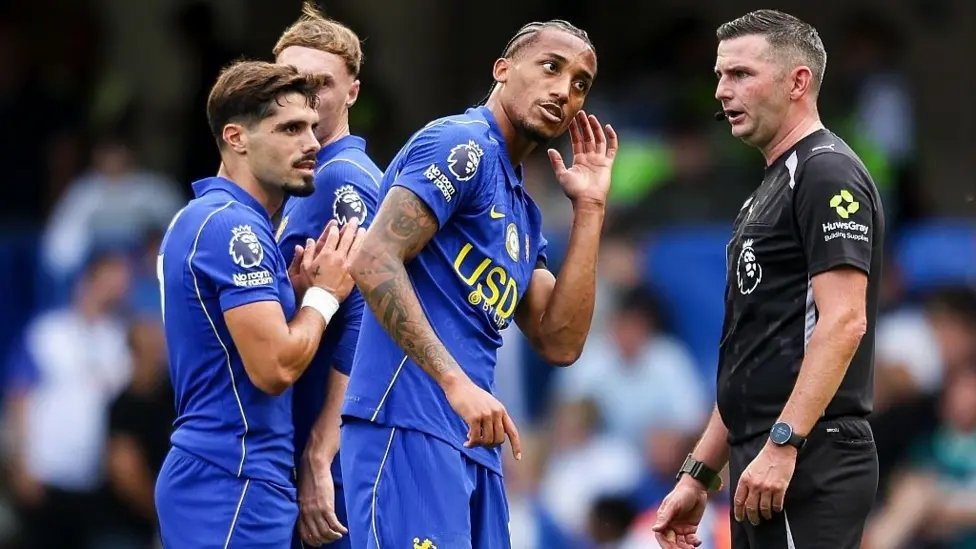
Michael Oliver and his fellow Premier League officials were forced to work without their usual communications equipment for the entire second half of Chelsea’s 4-3 win over Brighton at Stamford Bridge on Sunday.
Oliver returned to the pitch after half-time without his communications pack, in what may have been the first occasion in about 20 years that a group of Premier League officials had been required to continue without radio sets.
The referee was unable to communicate normally with assistants Stuart Burt and James Mainwaring, fourth official Tom Bramall or the Video Assistant Referee (VAR) team based at Stockley Park.
Referees were first equipped with a microphone and earpiece at the beginning of the 1999-2000 season. Although the technology was not immediately made a permanent feature, a later upgrade enabled more advanced radio communication systems to be introduced from the 2006-07 campaign.
There have been previous technical difficulties involving battery packs and communication links. On some occasions, matches have been delayed while a technician attempted to fix equipment attached to the arm of a referee or assistant.
However, Sunday’s incident was understood to be the first time officials had concluded that the problem could not be resolved and that they would have to continue without their headsets.
BBC Sport understands that crowd noise was not being filtered correctly through the system. That made it difficult for Oliver, Burt, Mainwaring and Bramall to hear one another clearly.
Under normal circumstances, the system reduces the impact of chanting, shouting and singing inside the stadium, allowing the officials to communicate effectively during the match.
Removing the headsets also raised a significant issue for VAR. Andrew Kitchen, who was operating from Stockley Park, could no longer speak directly to Oliver in the usual way.
The ability of a referee to discuss an incident with the VAR, including a possible penalty or red card, is a central part of the VAR protocol.
Kitchen therefore continued his work using a back-up arrangement. Messages could be sent to Oliver’s watch, while Kitchen retained radio contact with Bramall.
The change meant the VAR process had to operate differently. Checks were based solely on Kitchen’s own review of the video footage, rather than taking into account an account of the incident from the referee on the pitch.
Communication between the referee and VAR is designed to allow both officials to compare their assessments of incidents. Without that direct exchange, Kitchen had to carry out his checks according to his own view of what had happened.
The episode came at a time when referees are required to carry an increasing amount of equipment, including vanishing spray and RefCam technology. In that respect, Oliver and the other officials may at least have been taking to the field with less equipment than usual.
They may also have experienced a brief return to the conditions in which they began their careers in grassroots football, when officials had to operate without the modern communication systems now used at elite level.