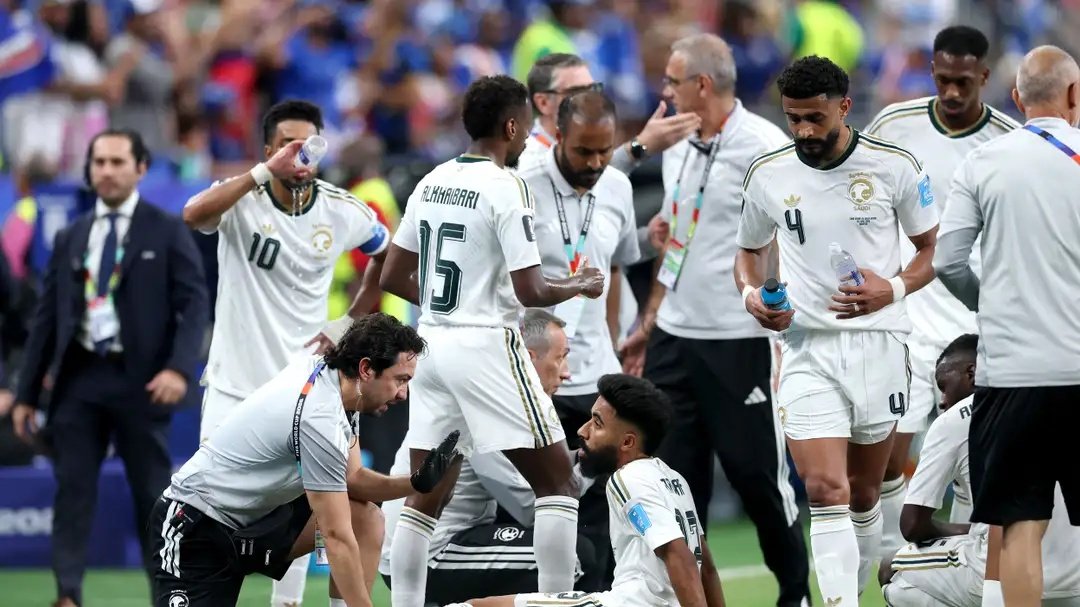
Saudi Arabia must address three recurring defensive problems before moving on to the next stage, football analyst Imad Al-Salmi has warned.
The issues were evident in the national team’s matches against South Korea and Uzbekistan, despite some positive aspects in both performances. Al-Salmi said the problems required serious attention from the coaching staff because some remained after changes were made, suggesting they were not linked to particular players or one specific line-up.
Speaking on the Rotana Sport with Walid programme, where he analysed Saudi Arabia’s 2-1 friendly defeat by Uzbekistan in Doha on Tuesday, Al-Salmi first questioned the risks involved in building play from the back.
He focused on the goalkeeper’s role in possession, with the goalkeeper effectively becoming an additional outfield player. While acknowledging that the approach reflected the coach’s ideas, he said it had to match the abilities of the players involved. Otherwise, he warned, it could become a risk that directly exposed the goal.
Al-Salmi said he had previously advised goalkeeper Mohammed Al-Owais to remain alert in such situations. He added that a coach should not be expected to persist with a particular method when the team lacks the right tools to execute it, and that abandoning the approach in those circumstances would be a natural decision.
Space in the centre
The most significant weakness, according to Al-Salmi, was how easily opponents were able to penetrate through the middle of the pitch. He said the problem had appeared against both South Korea and Uzbekistan.
He examined the roles of Nasser Al-Dawsari, Abdullah Al-Khaibari, Mohammed Kanno and Musab Al-Juwayr, arguing that the spaces left by the midfielders allowed opponents to reach dangerous positions and shoot without sufficient pressure.
In some situations, Saudi Arabia’s players moved towards the flanks to press, leaving the central areas exposed to the player in possession. Al-Salmi questioned whether that came from poor positioning or instructions involving targeted pressing, but said the outcome was the same: the most dangerous space was left unprotected.
He said the repeated nature of the problem meant the coaching staff needed to review both the pressing approach and the way space was covered.
Problems defending crosses
Al-Salmi also identified a lack of defensive organisation when dealing with crosses. The weakness was visible against South Korea and emerged again against Uzbekistan, when one delivery created a major threat before Abdulqodus Attiyah intervened to prevent the danger.
He stressed that the problem could not be attributed to one player. Instead, it concerned collective positioning and the way Saudi Arabia defended balls delivered into the penalty area.
That, he said, required clear work on the training ground rather than treating each incident as an isolated mistake.
Al-Salmi concluded that highlighting the shortcomings was not intended to overlook Saudi Arabia’s strengths. The purpose was to learn from the two matches and identify what needed improvement. He said protecting the centre, defending crosses and building from the back were as important as developing the team’s positive qualities, otherwise opponents could exploit the same weaknesses in future matches.