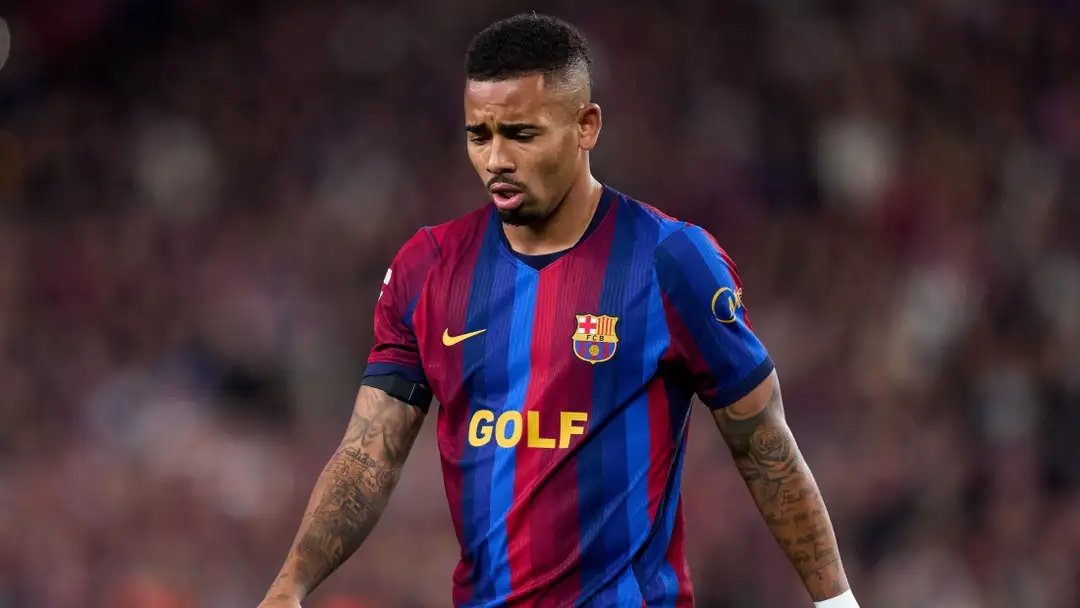
Gabriel Jesus’ move to Barcelona became possible only after Napoli failed to complete a deal for the Brazilian striker during last summer’s transfer window.
According to Spanish newspaper Sport, Barcelona pursued Julian Alvarez until the final stages of the window. The Argentina international was sporting director Deco’s first choice to strengthen the centre-forward position following Robert Lewandowski’s departure.
However, Atletico Madrid refused to consider selling Alvarez, forcing Barcelona to look elsewhere. After assessing the available alternatives, the Catalan club decided Gabriel Jesus represented a more affordable option and agreed to pay Arsenal 10m euros for the 29-year-old in late August.
Speaking when he was unveiled as a Barcelona player, Gabriel Jesus said he had immediately seized on the possibility of moving to the club.
“Players always have the final say, and I said: I want to play for Barcelona,” he said.
The striker had remained confident that a transfer would eventually materialise, but his move to Barcelona was helped by the failure of interested clubs to reach an agreement with Arsenal throughout the summer.
Italian sports journalist Ivan Zazzaroni said on Radio Kiss Kiss Napoli that Gabriel Jesus had spent six weeks waiting for Napoli to complete a deal.
“He is a wonderful young man and an exceptional person, and he was extremely excited about this opportunity,” Zazzaroni said. “But the Italian club could not complete the transfer, and he ended up at Barcelona.”
Napoli manager Massimiliano Allegri had made the Brazilian a target as he shaped his project at the club. Reports from Naples also indicated that Gabriel Jesus was strongly attracted by the prospect of playing at the Diego Armando Maradona Stadium.
Instead, Napoli’s failure to finalise the transfer allowed him to fulfil what he described as “the dream I had had since I was a child” by signing for Barcelona.
Gabriel Jesus has not yet established himself as a regular starter under Hans Flick. He has, however, made an impact when introduced from the bench, scoring four goals and providing two assists in 286 minutes.
Those figures have strengthened Barcelona’s attacking options, despite the striker remaining outside the club’s first-choice starting line-up.
The Brazilian’s route to Spain was therefore shaped by two separate setbacks in the transfer market: Atletico Madrid’s refusal to release Alvarez and Napoli’s inability to agree a deal with Arsenal.
Barcelona ultimately secured a player who had been prepared to wait for Napoli, but whose long-held ambition was to play at Spotify Camp Nou.